
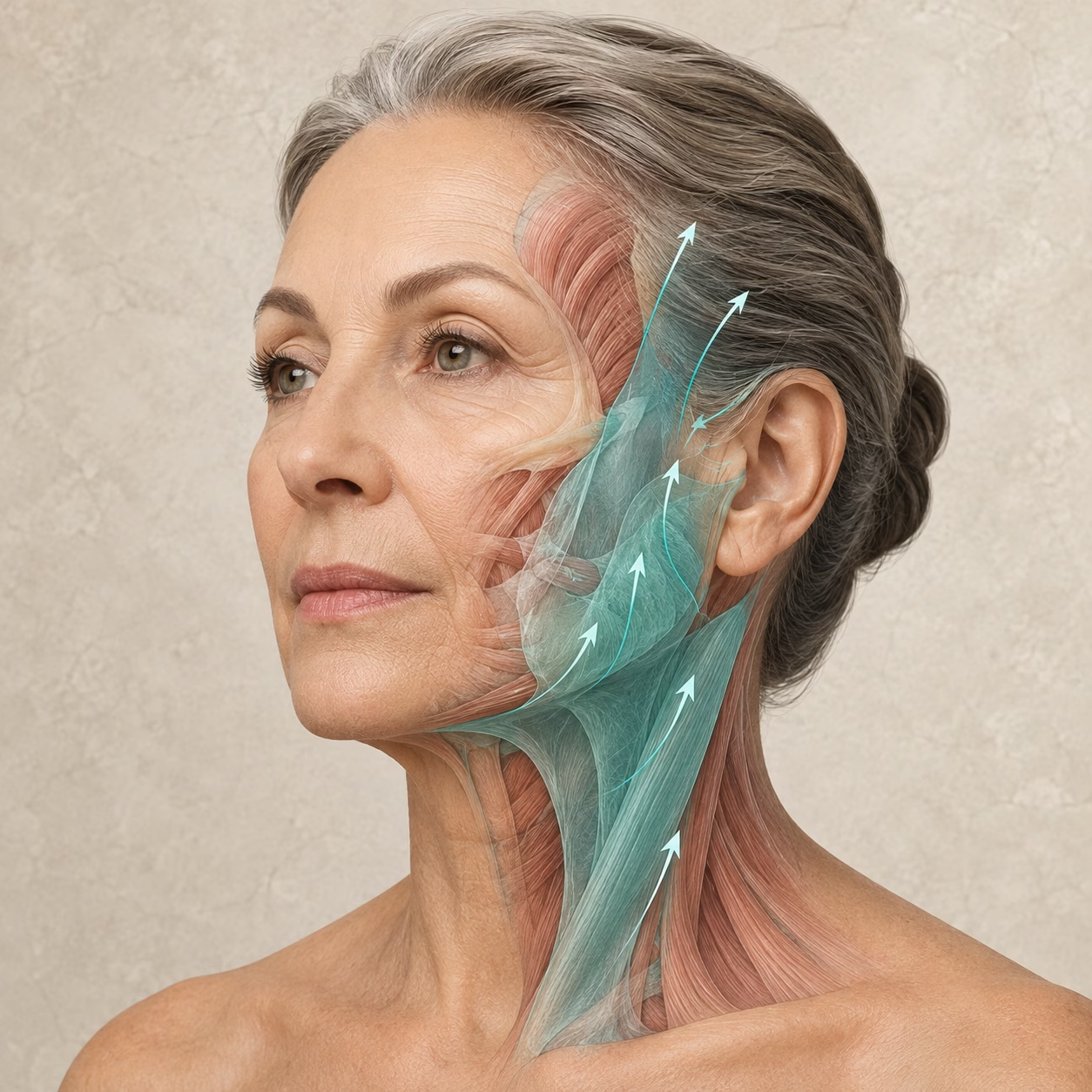

Facial ageing is often described as a problem of loose skin. In reality, the changes we see in the mirror involve much more than the skin alone.
Over time, the deeper supporting tissues of the face can descend, facial fat compartments can change position and retaining ligaments can become less effective. These changes may affect the cheeks, deepen the folds around the mouth, blur the jawline and create jowling. The relationship between the lower face and neck can also become less defined.
For this reason, modern facelift surgery should not be understood simply as pulling or removing excess skin. The aim is to identify which anatomical structures have changed and reposition the tissues in a way that respects the patient’s natural facial identity.
Deep Plane Facelift is one of the surgical approaches developed around this principle.
What Is a Facelift?
A facelift, medically known as rhytidectomy, is not one single standard operation. It is a general term covering several surgical techniques used to improve visible signs of ageing in the face and, when necessary, the neck.
Depending on the patient’s anatomy and the chosen technique, facelift surgery may involve the skin, the superficial musculoaponeurotic system — commonly known as the SMAS — the deeper supporting tissues, facial fat and the platysma muscle of the neck.
This is why two patients who both say they have undergone a facelift may actually have received very different operations.
The name of the procedure alone does not describe:
-
The anatomical plane in which the surgeon worked
-
Which retaining ligaments were released
-
How the deeper tissues were repositioned
-
Whether the neck was addressed
-
How much tension was placed on the skin
-
Which additional procedures were included
The operation must therefore be understood through its anatomical plan, not only through its name.
What Is the SMAS?
The SMAS is a fibromuscular layer located beneath the skin and subcutaneous fat of the face. It is connected to the facial muscles and continues towards the platysma muscle in the neck.
The SMAS plays an important role in facial ageing and facelift surgery because many of the visible changes associated with ageing are related to the position of the tissues connected to this layer.
Modern facelift techniques frequently address the SMAS in some form. However, the way the SMAS is treated varies between techniques. It may be tightened, folded, partially removed, elevated as a flap or mobilised together with other tissues.
Therefore, saying that an operation is a “SMAS facelift” does not, by itself, explain every detail of the surgical technique.
What Is a Deep Plane Facelift?
In a Deep Plane Facelift, the surgeon enters an anatomical plane beneath the SMAS in selected areas of the face.
Within this plane, retaining ligaments that restrict the movement of descended facial tissues can be carefully released. The skin, SMAS and associated soft tissues can then be repositioned as a more unified tissue layer.
The principle is not to pull the face as tightly as possible. It is to create sufficient mobility within the deeper tissues so they can be returned towards a more anatomically appropriate position.
This approach may be particularly relevant when ageing has affected:
-
The position and shape of the cheeks
-
The transition between the lower eyelid and cheek
-
The nasolabial folds
-
Jowling along the jawline
-
Lower-face definition
-
The relationship between the face and neck
The exact extent of surgery varies from patient to patient. A Deep Plane Facelift does not automatically mean that every facial or neck structure will be treated in the same way.
What Does “Traditional Facelift” Mean?
The expression “traditional facelift” is often used as though it describes one specific operation. In practice, it can refer to several different surgical approaches.
Some traditional techniques separate the skin from the underlying tissues and then tighten or reshape the SMAS. Others use SMAS plication, SMASectomy or different types of SMAS flaps.
These techniques should not automatically be described as outdated or ineffective. A well-planned SMAS-based operation can produce excellent results in an appropriately selected patient.
The meaningful difference is not that one technique is modern and another is old. The difference lies in:
-
The depth of dissection
-
The amount of tissue mobilisation
-
Whether retaining ligaments are released
-
The direction in which the tissues are repositioned
-
How facial and neck anatomy are evaluated
-
How the operation is adapted to the individual patient
The surgeon’s anatomical understanding, judgement and execution remain more important than the popularity of a surgical term.
How Does a Deep Plane Facelift Differ?
The principal difference is the anatomical plane in which the tissues are mobilised.
In many conventional SMAS techniques, the skin and SMAS may be elevated or treated separately. In a Deep Plane Facelift, selected areas are approached beneath the SMAS, allowing the overlying soft tissues to move together after the relevant retaining ligaments have been released.
This can provide greater mobility in areas such as the cheek and lower face without relying solely on skin tension.
The intended benefits may include:
-
Repositioning descended cheek tissues
-
Improving continuity between the cheek and lower face
-
Softening, rather than artificially filling, certain facial folds
-
Restoring a clearer jawline
-
Reducing reliance on excessive skin tension
-
Creating a more balanced relationship between the face and neck
However, these potential advantages do not mean that Deep Plane Facelift is automatically the correct procedure for every patient.
Does Deep Plane Facelift Produce a More Natural Result?
Naturalness does not come from the name of a technique alone.
A Deep Plane Facelift can support a natural-looking result because the deeper tissues are mobilised and repositioned rather than attempting to create the entire lifting effect through the skin. This may allow the skin to be redraped with less tension.
But the final appearance also depends on:
-
Correct patient selection
-
The surgeon’s understanding of facial anatomy
-
The direction and degree of tissue repositioning
-
Conservative management of the skin
-
The patient’s bone structure and tissue quality
-
Whether the face and neck are planned as a balanced unit
-
The healing process
An operation can be technically described as “deep plane” and still appear unnatural if the tissues are moved in an unsuitable direction or the patient’s individual anatomy is not respected.
My objective is not to create the same face in every patient. It is to improve the changes caused by ageing while preserving expression, proportions and recognisable identity.
Which Areas Can Be Improved?
A Deep Plane Facelift is primarily intended to address structural ageing of the midface and lower face.
Depending on the patient, it may improve:
Descended Cheeks
Ageing can cause the soft tissues of the cheek to move downwards. Repositioning these tissues may restore a more balanced cheek contour without simply adding volume.
Nasolabial Folds
The folds extending from the sides of the nose towards the corners of the mouth can become more prominent as the cheek tissues descend. A facelift may soften these folds, although completely erasing them would neither be realistic nor necessarily natural.
Jowls
Jowling develops when lower-face tissues descend across the border of the jaw. Repositioning these tissues can help restore a more continuous jawline.
Jawline Definition
The jawline may become blurred because of several factors, including tissue descent, skin laxity, fat distribution, platysma changes and the patient’s underlying bone structure. Each of these factors must be evaluated separately.
Face and Neck Continuity
The face and neck are anatomically connected. In some patients, treating the face without addressing significant neck changes may create an incomplete result. In others, the neck may not require additional intervention.
Deep Plane Facelift does not automatically correct every neck concern. Neck surgery must be planned according to the structures involved.
What Can a Facelift Not Correct?
A facelift can reposition descended tissues, but it is not designed to solve every sign of facial ageing.
It cannot completely correct:
-
Fine surface wrinkles
-
Sun damage
-
Uneven pigmentation
-
Enlarged pores
-
Every type of volume loss
-
Upper-eyelid or brow ageing
-
All forms of neck fullness
-
The patient’s underlying bone structure
Skin-quality treatments, eyelid surgery, brow surgery, fat grafting or other complementary procedures may be considered when clinically appropriate. They are not automatically required for every patient.
The aim should be to perform the procedures that are genuinely necessary, not to add as many procedures as possible.
Who May Be Suitable for a Deep Plane Facelift?
Suitability is determined by anatomy and health rather than age alone.
A person may be considered for this approach when there is meaningful descent of the cheeks or lower-face tissues, jowling, reduced jawline definition or an imbalance between the face and neck that cannot be adequately addressed with limited non-surgical treatments.
Assessment also includes:
-
General health
-
Medical history
-
Previous operations
-
Previous fillers or thread treatments
-
Current medications and supplements
-
Smoking
-
Skin and tissue quality
-
Facial nerve anatomy
-
Expectations and personal priorities
Some patients may benefit from a different facelift technique. Others may not need surgery at all.
The correct operation is not the most extensive operation. It is the operation that accurately addresses the patient’s anatomical problem.
Is Deep Plane Facelift Better Than Every Other Technique?
No surgical technique should be presented as universally superior.
Different facelift methods have different indications, advantages and limitations. The appropriate choice depends on the patient’s anatomy, the areas requiring treatment and the surgeon’s training and experience.
For one patient, a Deep Plane Facelift may offer the required degree of tissue mobilisation. For another, a different SMAS-based technique or a more limited operation may be appropriate.
The better question is not:
“Which facelift is the best?”
It is:
“Which anatomical changes need to be corrected, and which surgical approach can address them most appropriately?”
Will the Results Last Forever?
No facelift stops the biological ageing process.
The repositioned tissues continue to age after surgery. Genetics, skin quality, sun exposure, smoking, weight changes and lifestyle can all influence how the face changes over time.
A successful result should therefore not be understood as freezing the face at one age. The goal is to create a meaningful and balanced improvement from which the patient continues to age naturally.
The longevity of the result varies between individuals and should never be presented as an exact guaranteed number of years.
Why Is the Consultation So Important?
The consultation is where the surgical plan begins.
I evaluate the face from the front, profile and oblique angles. I assess cheek position, jowling, jawline continuity, skin quality, facial volume, neck contour and the relationship between the soft tissues and underlying bone structure.
I also listen carefully to what the patient wants to improve and, equally importantly, what they do not want to change.
Clinical photographs and older personal photographs may help us understand the patient’s natural proportions and how the face has changed over time. The intention is not to reproduce an old photograph exactly, but to plan surgery with respect for the patient’s original facial identity.
Risks and Individual Medical Assessment
Deep Plane Facelift is a surgical procedure and carries potential risks.
These may include bleeding or haematoma, infection, delayed wound healing, visible or widened scars, temporary or persistent sensory changes, asymmetry, hairline changes, skin-healing problems, facial nerve weakness and risks associated with anaesthesia.
The individual level of risk depends on the patient’s health, anatomy, medications, smoking status, previous treatments and the scope of surgery.
A website article cannot determine whether someone is suitable for an operation. That decision requires a detailed medical history, physical examination and an individual discussion of the expected benefits, limitations and risks.
Conclusion
Deep Plane Facelift differs from more conventional facelift approaches primarily through the anatomical plane in which the surgeon works and the way the deeper facial tissues are mobilised.
Its purpose is not to pull the skin tighter or create a different face. The aim is to reposition the tissues affected by ageing while preserving the patient’s expression, proportions and identity.
For me, successful facial rejuvenation is not defined by how dramatically a face has changed. It is defined by whether the patient looks rested, balanced and recognisably like themselves.
The technique matters. But thoughtful planning, anatomical precision and appropriate patient selection matter even more.
Op. Dr. Oğuz Kılıç
Plastic, Reconstructive and Aesthetic Surgeon



1 Comment
A WordPress Commenter
Hi, this is a comment.
To get started with moderating, editing, and deleting comments, please visit the Comments screen in the dashboard.
Commenter avatars come from Gravatar.