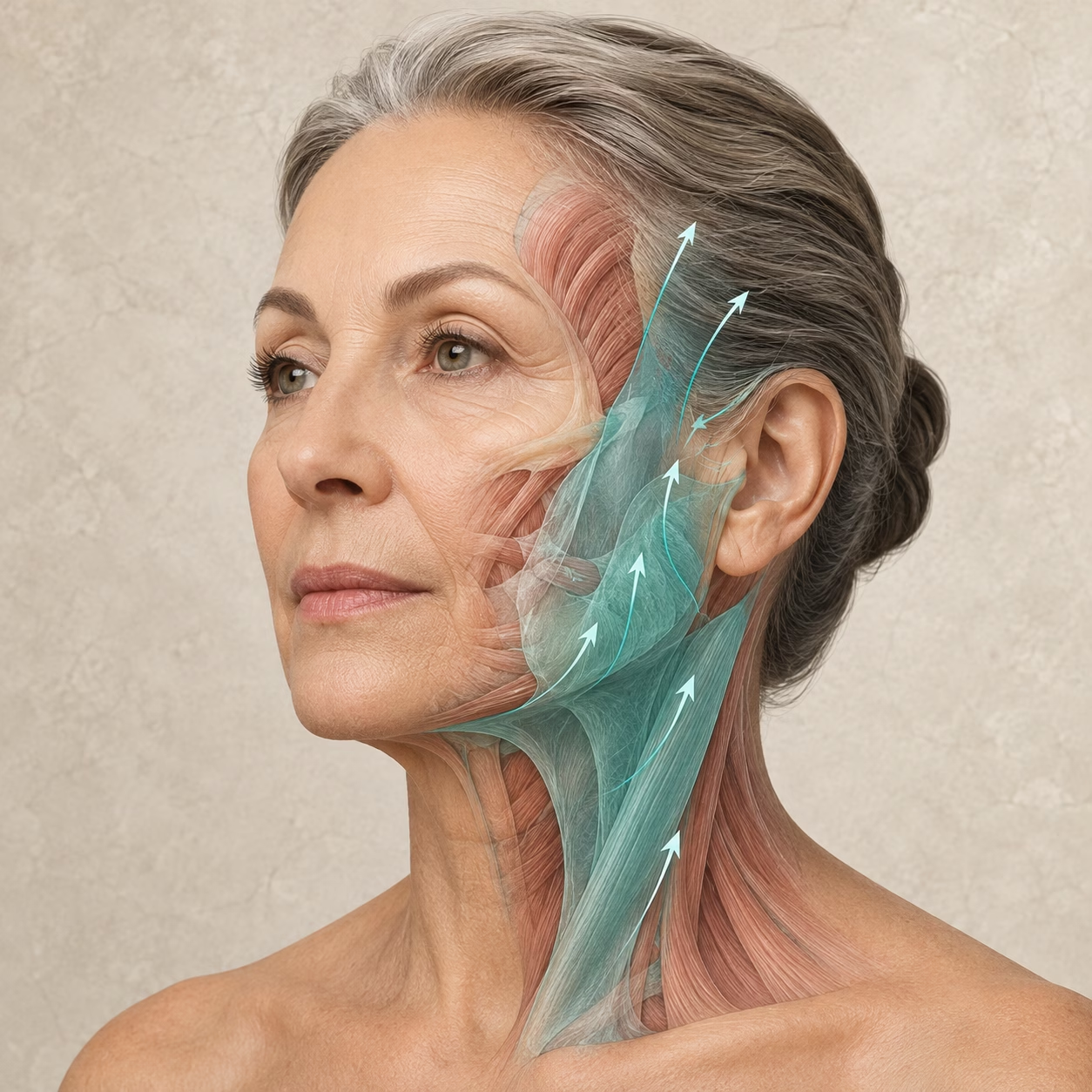

When patients research facelift surgery, two terms appear repeatedly: Deep Plane Facelift and SMAS Facelift. They are often presented as competing operations. In reality, both are established approaches that work beneath the skin, and both can produce refined results when selected and performed appropriately.
The important question is not which name sounds more advanced. It is which anatomical problem needs correction, how much tissue mobilisation is required and which technique allows the surgeon to create a balanced result without excessive skin tension.
What is the SMAS?
SMAS stands for the superficial musculoaponeurotic system. This fibromuscular layer lies beneath the skin and subcutaneous fat, connects with the muscles of facial expression and continues towards the platysma in the neck.
Ageing affects more than skin. Deeper soft tissues descend, retaining ligaments provide less support, fat compartments change and the jawline loses definition. Modern facelift surgery therefore aims to reposition deeper support rather than simply stretch the skin.
What is a SMAS Facelift?
“SMAS Facelift” is a broad term, not one standard operation. It includes techniques that fold, tighten, remove or elevate part of the SMAS. SMAS plication, SMASectomy and different SMAS flap procedures may all be described by the same general label, although their extent differs considerably.
In a well-planned SMAS facelift, the deeper layer carries much of the lifting force. The skin can then be redraped more gently, helping to avoid an overly tight appearance.
What is different in a Deep Plane Facelift?
In a Deep Plane Facelift, the surgeon enters beneath the SMAS in selected areas and releases specific retaining ligaments that restrict tissue movement. The skin and SMAS can then be mobilised as a connected unit.
This release may allow descended cheek, lower-face and jawline tissues to move with less surface tension. It can be particularly useful when broader mobilisation of the midface and lower face is required.
“Deep” does not mean every part of the operation is performed at one depth. Facial anatomy changes from region to region, and safe surgery requires precise knowledge of nerves, vessels, salivary structures and tissue planes.
The main differences
Dissection and ligament release
SMAS techniques manipulate the SMAS in different ways. Some tighten it without creating a large flap; others elevate it more extensively. Deep plane surgery continues beneath the SMAS in defined regions and usually releases key retaining ligaments. Some extended SMAS operations may also release ligaments, so the distinction is not always as simple as a marketing diagram suggests.
Tissue movement and skin tension
Both approaches should avoid using skin as the main lifting structure. When deeper tissues provide support, skin can be closed with less tension. This matters for expression, hairline preservation, ear shape and scar quality.
Areas treated
A Deep Plane Facelift can directly mobilise descended cheek tissues while improving jowls and the jawline. SMAS techniques can also create meaningful lower-face and neck rejuvenation. The result depends on the exact method, the patient’s anatomy and the surgeon’s execution.
Does deep plane always look more natural?
No technique guarantees a natural result because of its name. Natural-looking surgery depends on direction, degree of correction, face-and-neck balance, volume management and respect for the patient’s identity.
A technically sound SMAS facelift can look very natural. A poorly planned deep plane procedure can look unnatural. The operation must serve the anatomy rather than the popularity of a label.
Are recovery, scars and safety different?
Both procedures generally use incisions around the ear and within or along the hairline. A neck procedure may add a short incision beneath the chin. Recovery varies with the extent of surgery, associated procedures and individual healing more than with the procedure name alone.
Both approaches carry risks, including bleeding or haematoma, infection, delayed healing, skin problems, fluid collection, visible scars, asymmetry, sensory change and temporary or, rarely, permanent nerve injury.
Recent systematic reviews found high satisfaction and meaningful improvement with both SMAS and deep plane techniques. Direct comparative evidence remains limited and varied, so current research does not justify calling one method universally safer or superior for every patient.
Which approach is right for me?
The plan should consider cheek descent, jowling, neck laxity, skin quality, previous treatments, scar history, general health and the degree of change the patient wants. Some patients need wider mobilisation; others benefit from a more limited operation.
Ask which tissues will be repositioned, where the incisions will be placed, how the face and neck will be balanced and why the proposed method fits your anatomy. Technique matters, but judgement, anatomical knowledge and patient selection matter just as much.
Op. Dr. Oğuz Kılıç
Plastic, Reconstructive and Aesthetic Surgeon