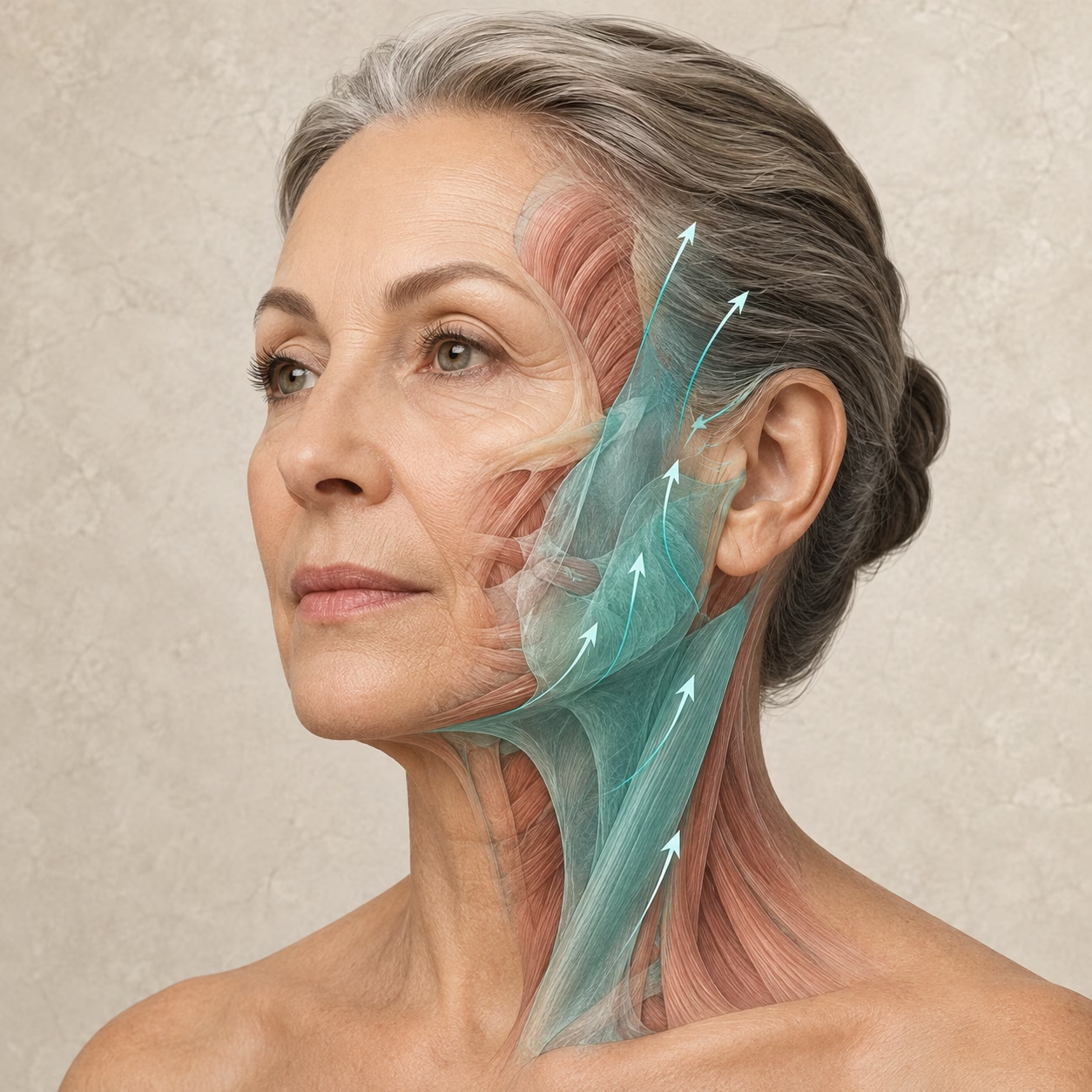

Patients often describe the face and neck as separate concerns: “I only want my jowls treated,” or “I only dislike my neck.” In some cases, limited treatment is appropriate. In many others, the visible problem crosses the boundary between the two regions.
The cheek, jawline, area beneath the chin and neck form a continuous anatomical and visual unit. Evaluating them together does not mean every patient needs the same combined operation. It means the plan should understand how one region affects the other.
The anatomy is connected
The SMAS of the face continues towards the platysma in the neck. Jowling may reflect lower-face descent, while neck fullness or banding may involve loose skin, fat, platysma separation or deeper structures. Chin projection and bone anatomy also influence the neck angle.
A visible “neck problem” may therefore not originate in the neck alone.
Why face-only treatment can look incomplete
If the cheeks and jowls are repositioned but significant neck laxity remains, the jawline may end abruptly or lack a clean transition beneath the chin. The face may look refreshed while the neck shows a different degree of ageing.
This does not mean the neck must always be operated on. Leaving it untreated should be a conscious decision after examination.
Why neck-only treatment can also be unbalanced
A sharply defined neck beneath persistent jowls may look disconnected. Neck treatment alone may not correct tissue that has descended over the jaw. Liposuction can reduce selected fat but cannot reposition significant loose skin or solve every cause of a soft jawline. Removing too much fat may expose laxity or deeper structures.
What should be assessed?
Evaluation may include cheek descent, jowls, skin elasticity, submental fat, platysma bands, chin projection, deeper neck anatomy, previous treatment, asymmetry and scar history. No single operation corrects every finding.
A face-only approach may suit a patient whose neck remains well defined. A neck-focused procedure may suit someone whose facial tissues remain supported but who has localised submental or platysma concerns. Both decisions still require assessment across the jawline.
What can a combined plan involve?
Depending on anatomy, it may reposition facial support, treat the platysma, manage selected fat and redrape skin with controlled tension. A small incision beneath the chin may be used for direct central-neck access. Not every element is required for every patient.
The objective is not maximum tightness. Overcorrection can distort natural contours. Face and neck should look like they belong to the same person and the same stage of ageing.
Ask whether the concern comes from the face, neck or both; what causes the lost jawline; whether direct platysma treatment is needed; and what a limited procedure would leave unchanged.
Good planning follows anatomy rather than page headings. The final operation may be limited or comprehensive, but it should create one coherent result from the cheek to the jawline and from the jawline to the neck.
Op. Dr. Oğuz Kılıç
Plastic, Reconstructive and Aesthetic Surgeon